


 Advanced DNS Security
 Cortex
 Unit 42 Incident Response


Executive Summary
A recent Unit 42 investigation into seemingly low-priority enterprise infections demonstrates how the most effective camouflage in cybercrime is not necessarily in the use of sophisticated techniques, but in how unremarkable the threat appears. The activities that we investigated would typically not require escalation or further inquiry. But upon closer inspection, we discovered a massive cybercrime campaign largely targeting young gamers. Tracked as CL-CRI-1171, in accordance with Unit 42’s attribution framework, the group behind this cluster has operated under the radar for at least two years, distributing an indeterminate number of payloads.
The group behind CL-CRI-1171 provides an infection service for other threat actors who want to spread their malware indiscriminately. This pay-per-install (PPI) marketplace drove hundreds of infections through YouTube channels and a parallel search engine optimization (SEO)-poisoning funnel, all using the same custom loader.
We observed at least eleven YouTube channels that had hundreds of thousands of followers. We notified YouTube of these channels, which it promptly terminated.
These channels were actively interacting with viewers to promote gaming content laced with links to download malware. Content in the channels included advice on improving frame rates, fixing game crashes and adjusting settings on game platforms. Although the videos provided real content for gamers, they also served as the delivery vehicle for infection, prompting viewers to download malicious tools.
The SEO funnel targeted a more professional audience, promoting trojanized software that resulted in malware deployment on corporate endpoints, including critical infrastructure and even government entities. We identified three independent payloads delivered by the same loader between July 2025 and April 2026: two never publicly reported, Docro Hijacker and ARKTunnel, and a new variant of a previously unnamed backdoor, which we dubbed Insomnia remote access Trojan (RAT).
These infections represent only a small sample of a much larger deployment campaign. We have identified more than 10,000 distinct loader samples, each capable of delivering unique payload combinations.
We provide an overview of the cybercrime cluster and its loader infrastructure, and a technical analysis of three recently delivered malware strains.
Palo Alto Networks customers are better protected from the threats discussed in this article through the following:
If you think you might have been compromised or have an urgent matter, contact the Unit 42 Incident Response team.
| Related Unit 42 Topics | SEO Poisoning, Browser Hijacking, RATs |
Overview of CL-CRI-1171 Activity
Our discovery of two separate infections delivering three entirely distinct malware families revealed one common denominator: a shared loader. By tracing this infrastructure, we mapped the broader activity of CL-CRI-1171, ultimately tying the cluster to a PPI marketplace responsible for delivering countless payloads over the last two years.
This operation uses at least two funneling mechanisms to route traffic to the malware landing pages: a network of YouTube channels and SEO poisoning. The shared infrastructure between the YouTube and SEO funnels, consistent use of the same loader and a rotational domain pattern observed over an eight-month window all pointed to a single sustained operation, which we track as CL-CRI-1171.
The PPI Ecosystem: An Infection Marketplace
PPI networks operate as underground marketplaces. An operator compromises machines and auctions access to multiple buyers, each buyer deploying their own independent payloads through the same dropper. The result is a single infection that conceals multiple payloads from unrelated threat actors on the same endpoint, each with its own C2 infrastructure and objectives. Because the loader is designed to be disposable and generic, it rarely attracts the scrutiny needed to uncover its subsequent payloads.
Tracking CL-CRI-1171: The PPI Operation Behind the Payloads
The investigation began with two identical and seemingly routine infections at separate organizations. Both events involved trojanized software downloads — one a Bluetooth driver, the other WinDirStat — and both affected machines executed an identical post-exploitation chain. The loader was unnamed, untracked and generic enough to be dismissed as commodity adware.
But our discovery of a shared payload chain raised a question. How were two unrelated organizations infected by the same unnamed loader delivering the same set of payloads, just one week apart?
Pivoting on the loader's C2 infrastructure revealed a sprawling network of rotational domains — over 200 unique hostnames following a distinctive two-word compound naming pattern (including bubbleslip, churchpail, dinosaursjam), rotating across .xyz, .cfd, .space and .info top-level domains (TLDs).
Unpacking the Delivery Infrastructure
The payloads delivered through CL-CRI-1171's infrastructure are not fixed, enabling the simultaneous delivery of unrelated malware families. In April 2026, two incidents initiated this investigation. They shared a single loader that delivered three separate malware families: Insomnia RAT, ARKTunnel and Docro Hijacker. A subsequent infection, observed in June 2026, delivered two entirely different payloads: GCleaner and Socks5Systemz.
Figure 1 illustrates the structure of the operational architecture and the observed rotational malware bundles.
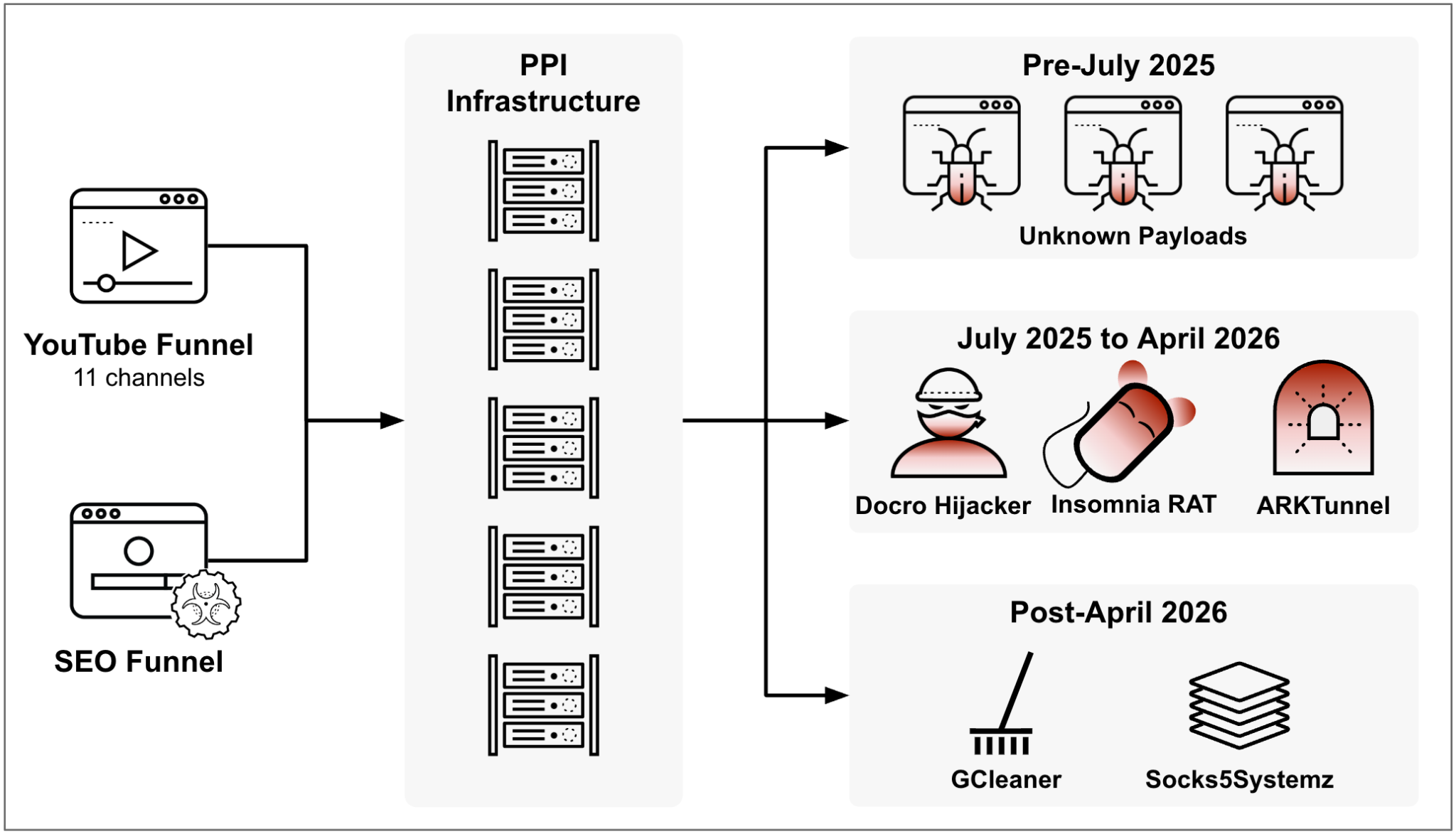
Our in-depth analysis explores three operations that were spotted in two intrusion sets during April 2026. By examining the campaign’s trackers, we found that these operation payloads were in rotation from July 2025 to April 2026. This discovery provides a valuable snapshot of the group’s deployment capabilities and the variety of payloads they have been entrusted to deliver.
Although the observed rotation appears to be highly structured, the discovery of over 10,000 unique OfferLoader samples points to a much larger distribution pipeline. It is very likely that the loader has delivered numerous other malware families.
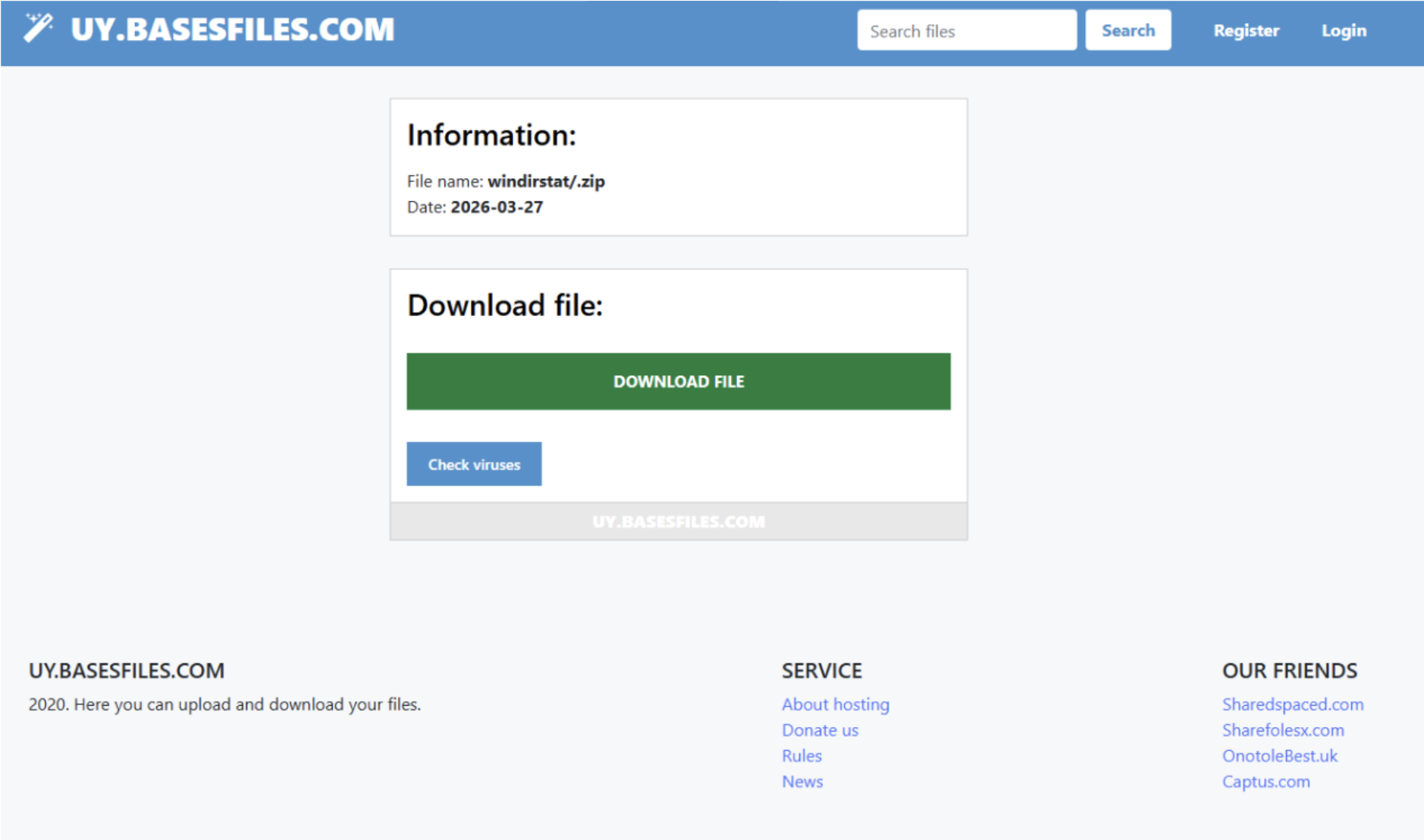
The SEO poisoning path was the first delivery channel we identified. Unsuspecting users searching for legitimate software landed on file-hosting lure pages that displayed a fake virus-scan animation before delivering the trojanized archive via a chain of redirectors into the PPI gate.
A reconstructed example download page from the SEO poisoning funnel is shown in Figure 2.
Analysis of the gate's tracker URLs revealed a critical detail. Each URL contained a click_id parameter: a Base64-encoded fingerprint containing the victim's operating system (OS), browser, the referring domain, the exact search keyword that led them to the lure and their public IP address, as Table 1 shows.
| Operating System | Browser | Referring SEO Domain | Search Keyword | Victim IP |
| Windows_10 | Chrome | atthelake[.]info | hwidspoofer | 5.xxx.xx.xxx |
| Windows_10 | Chrome | atthelake[.]info | combatwarriorsGit | 2.xx.xxx.xx |
Table 1. Example of a deobfuscated click_id.
The gate uses this fingerprint to decide who receives the payload: a valid, fresh click_id forwards the visitor to the malware/loader download. This is an evasion tactic used to ensure that only real targets are infected, and to protect the actor’s infrastructure: scanners, crawlers or analysts receive a decoy clone of the legitimate WinRAR download page or broken links. This is why the campaign has almost no public footprint despite being highly active: automated URL scanners rarely pass the gate.
Decoding hundreds of these fingerprints, with the assistance of AI, exposed the full names of YouTube video titles and their associated channels. Alongside search keywords for cracked software and game cheats, the q= field – which tracks which search query led to the infection – contained strings like "CS2 Potato Graphics Settings - Maximum FPS Boost for Low-End PC (2026 Guide) - Velvox."
The YouTube Funnel
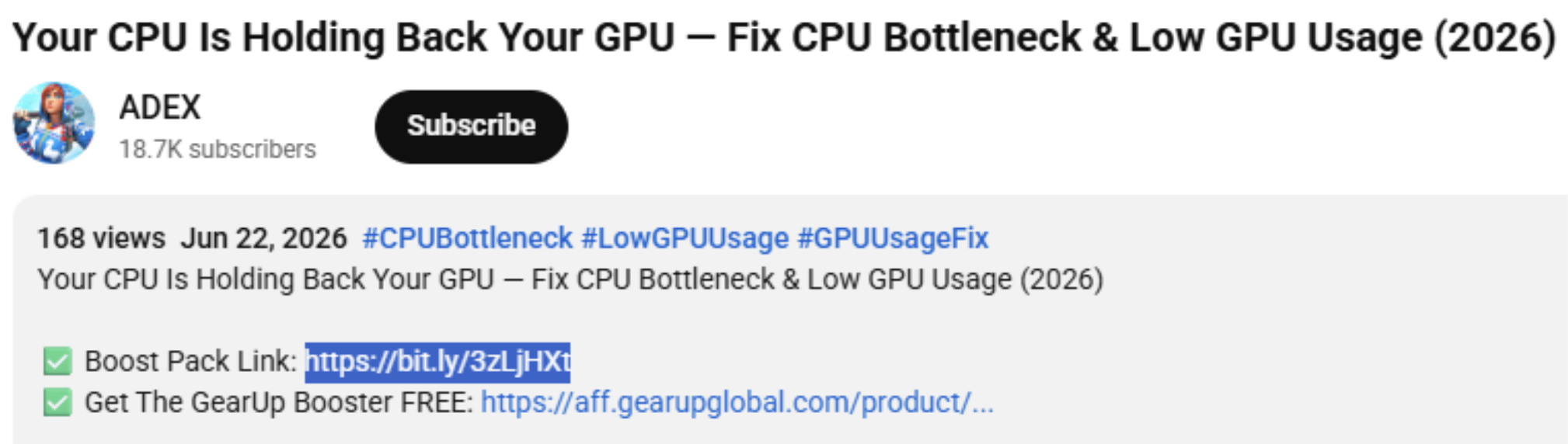
Searching for titles derived from the fingerprints led us to uncover a chain of gaming optimization YouTube channels. Their content included tips on boosting frames per second (FPS), fixing game crashes and tweaking settings on popular game platforms. While the videos provided authentic, engaging content for young gamers, they ultimately served as an infection delivery vehicle, prompting viewers to download a malicious “tool” or “optimization pack” via links in the description, as Figure 3 shows.
Those links pass through intermediary sites, such as Blogspot, which contain social-engineering instructions that lead the victim to the same PPI gate infrastructure serving the SEO path. An example blog page is shown in Figure 4.

We identified 11 channels connected to CL-CRI-1171, which collectively had hundreds of thousands of subscribers and millions of views.
Technical Analysis
Our investigation revealed three malware strains delivered by the group behind CL-CRI-1171 between June 2025 and April 2026. The following sections explain the technical aspects of the loader used by this cybercrime group and the deployed malware payloads:
- OfferLoader – The delivery mechanism behind all recorded intrusions, an Inno Setup trojanized installer that sets up the other payloads.
- Operation A: Insomnia RAT – A dual-payload, cross-platform backdoor that brings its own environment to ensure survival. Targeting both Windows and macOS using Node.js, paired with a twin Python agent.
- Operation B: ARKTunnel – A previously unreported WebSocket tunneling RAT unpacks itself from a bitmap image using steganography. We found 50 samples spanning over a year of development, operating across four fictitious corporate-identity rotations.
- Operation C: Docro Hijacker – A Chrome backdoor that revives a browser-hijacking technique first seen in 2015, re-engineered to bypass modern integrity protections. This campaign represents the first observation of this modern variant in the wild.
Initial Access Vector in Intrusions
We discovered two intrusion sets that began in the same way: a user searched for a legitimate utility, clicked a top search result that led to a malicious domain, and downloaded what appeared to be a legitimate application. Both infections delivered the same three payloads.
- First intrusion set: Downloaded Bluetooth Driver for Windows 10.exe from a file-sharing archive. The installer was a trojanized Inno Setup package carrying the PPI loader with affiliate ID CID=2855.
- Second intrusion set: Browsed to noiseship[.]cfd, a domain registered just 39 days earlier, and downloaded a trojanized windirstat.exe installer. This package carried the PPI loader with affiliate ID CID=3075.
The OfferLoader Execution Chain
The operator's code and C2 communication designate each payload slot as an "offer," tracking variables as offer_execution, offer_execution_fail and offer_exists. Based on the naming convention, we track this loader as OfferLoader. OfferLoader uses chained Inno Setup (a legitimate installation packager) packages to deliver multiple payloads. Figure 5 shows the infection chain.
OfferLoader is delivered in a ZIP file, with the source download site providing the social engineering instructions required to guide users through downloading and executing an extraction tool. Based on our analysis of the collected samples, we observed the loader being delivered alongside a legitimate version of WinRAR, renamed to .store. The installer contains no embedded application files; all malicious logic is contained in the compiled Pascal [Code] section, which triggers when the installation page is displayed.
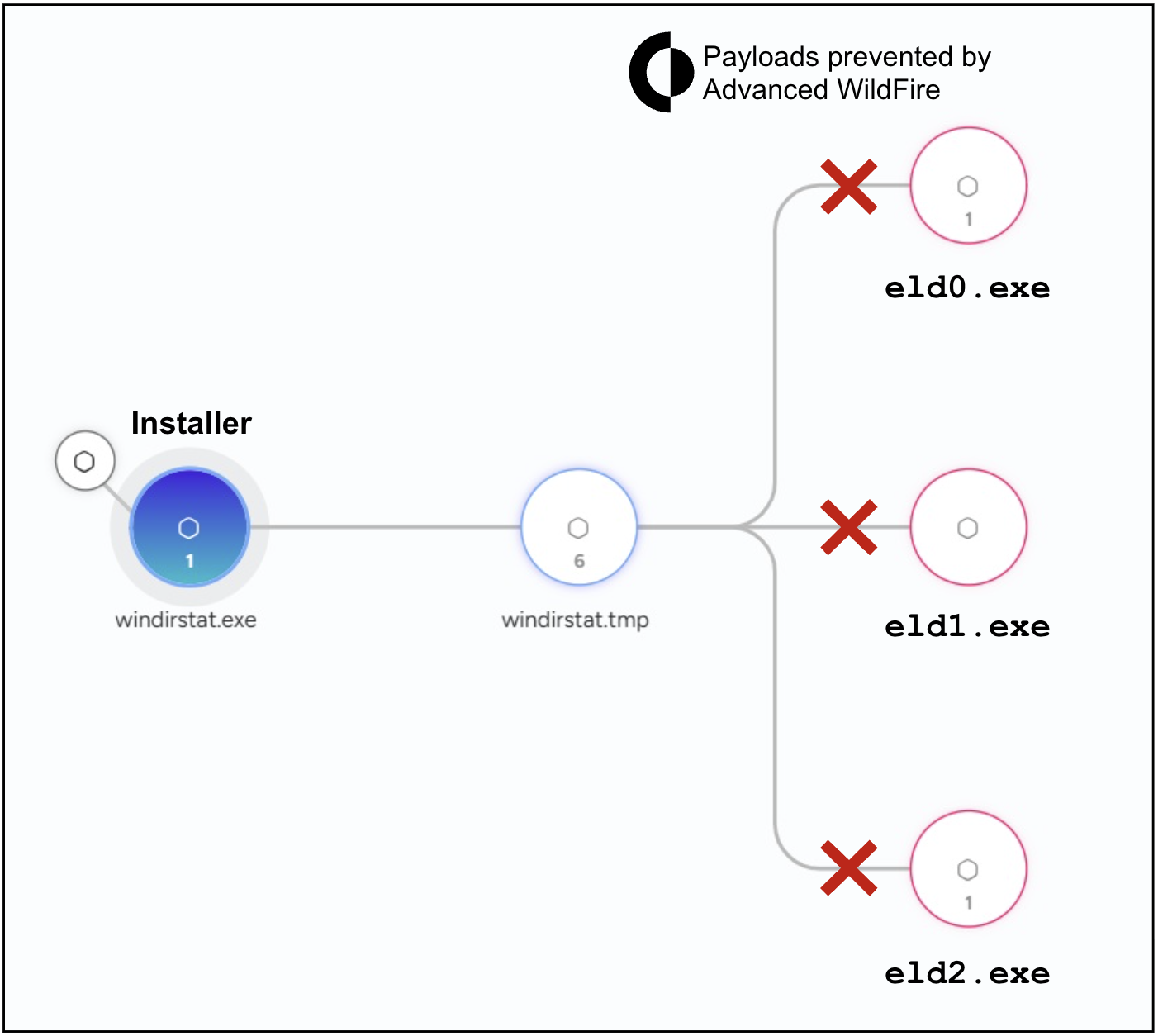
In two separate intrusion sets we discovered that the ZIP file contained OfferLoader masquerading as a windirstat.exe installer that initiates the compromise by unpacking windirstat.tmp. This temporary file transmits an initial tracking beacon to voyagemist[.]space. This is another gating mechanism: depending on the structure of the beacon, one of two text files will be retrieved. They either contain “no” to signal that the loader should not unpack further stages, or “ok” to signal all offers will be deployed. Following this check-in, the process spawns three child processes: eld0.exe, eld1.exe and eld2.exe. Each child process corresponds to a different malware campaign. The loader passes specific affiliate-tracking parameters to each process via a command line.
Figure 6 illustrates the entire OfferLoader infection chain at the time of the intrusion.
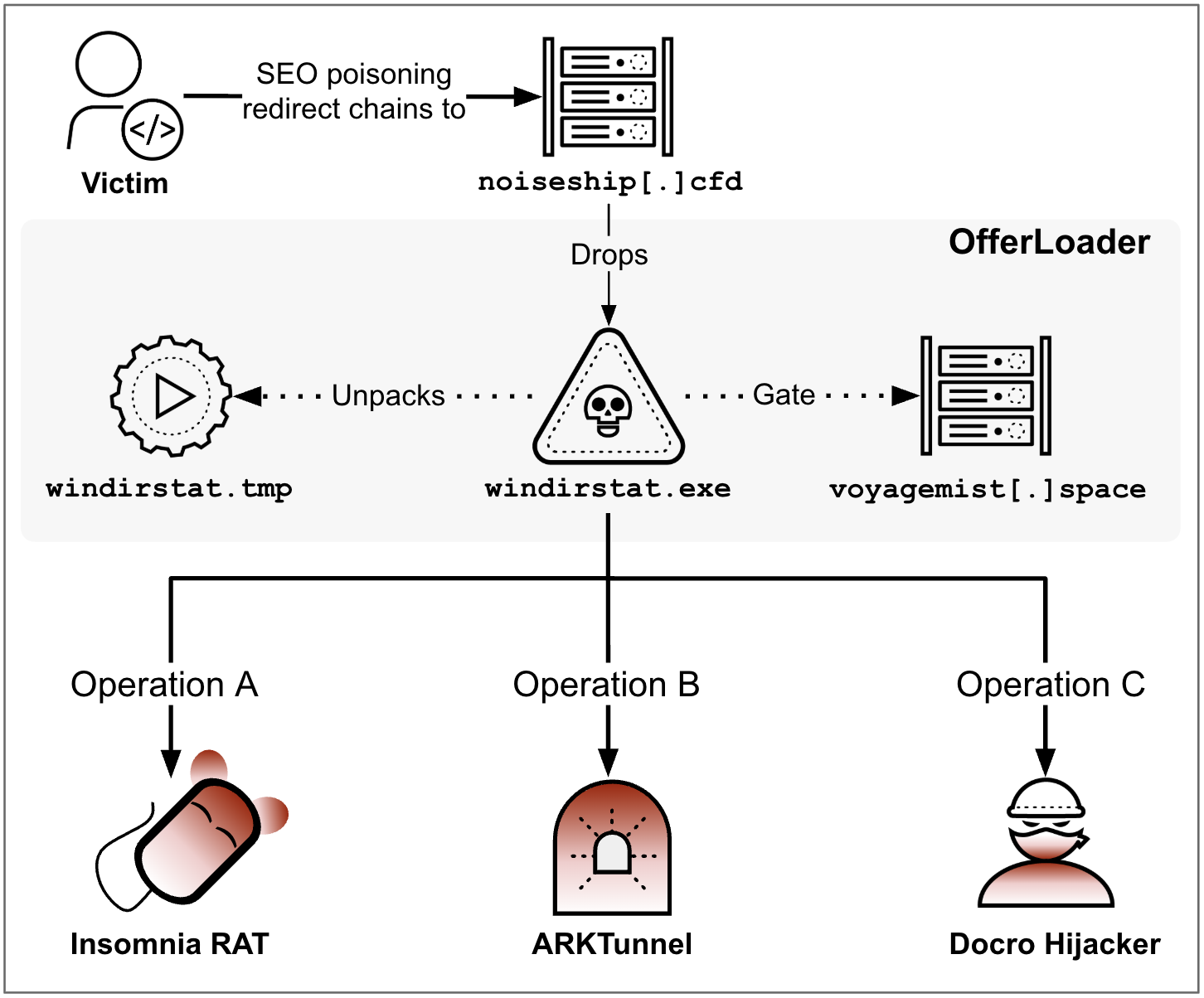
OfferLoader's role ends once the three offers are spawned. From this point forward, each child process operates as an independent malware campaign with its own infrastructure, C2 protocol and objectives. The following sections analyze what each offer delivers.
Operation A: Insomnia RAT – A Cross-Platform Backdoor
Insomnia RAT simultaneously distributes two payloads:
- An upgraded variant of a Node.js backdoor (reported by Walmart Global Tech in 2025)
- A complementary Python backdoor
We have dubbed these twin payloads Insomnia RAT, due to the user-agent string used for C2 communications: insomnia/2023.4.0 Windows.
Figure 7 shows the full infection chain that delivers Insomnia RAT’s twin payloads.
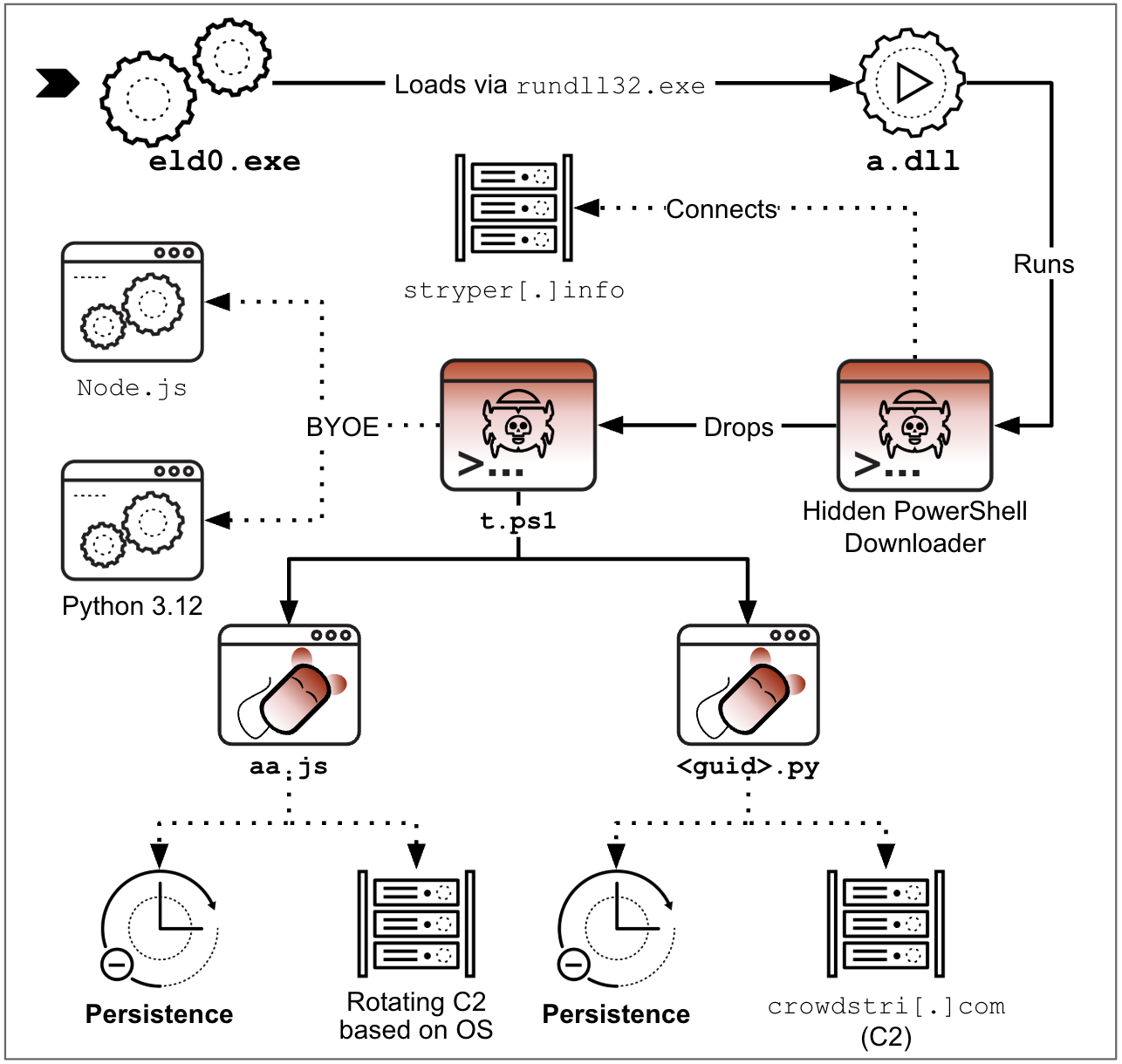
Eld0.exe drops the a.dll payload and spawns a hidden PowerShell process to download and execute t.ps1. This double-stage installer script disables Windows Defender protections, adds the entire C:\ drive as an exclusion, suppresses security notifications and deploys the two Insomnia RAT backdoors. t.ps1 also downloads and sets up the environment needed to execute both backdoors by installing Python and Node.js on the victim’s machine. Node.js is hidden from the system's Add/Remove Programs list by setting SystemComponent=1 in the registry.
The first part of Insomnia RAT is a Node.js agent downloaded from stryper[.]info/aa.js. While the prior variant targeted Windows, Linux and FreeBSD with a single payload, this iteration targets Windows and macOS using platform-specific C2 server lists. It also deploys a companion Python agent as a redundant fallback, ensuring persistent access if one runtime environment is detected or removed.
The backdoor collects the victim's MachineGuid, universally unique identifier (UUID), hostname and operating system details. It then contacts its C2 servers via an HTTPS POST request to /d using a User-Agent string, insomnia/2023.4.0 Windows to disguise itself. The C2 server responds with a JSON array containing commands. These specify a payload type (node, cmd, ps1, sh, or ow for a self-update) and a download URL. Results are reported back to the /e endpoint.
To establish persistence, the installer registers a scheduled task named Maps Performance Task under \Microsoft\Windows\Maps\. This mimics a legitimate Windows task, executing the backdoor hourly and at system startup under the SYSTEM account.
The same t.ps1 script installs a second, redundant agent. This Python script is downloaded from aa.amazingshield[.]xyz. The installer downloads a legitimate Python distribution and registers a second scheduled task, OOBETaskScheduler, under \Microsoft\Windows\Servicing\.
The Python agent is simpler than its Node.js sibling, but follows the same C2 protocol pattern: POST requests to /d for tasks and POST requests to /e for error reporting. The agent collects the MachineGuid, OS product name, hostname and processor architecture.
The Python agent used crowdstri[.]com as its C2 domain. This appears to be a deliberate typosquat of crowdstrike[.]com, designed to blend into logs and evade quick security reviews.
Operation B: ARKTunnel – A WebSocket RAT Hidden in a Bitmap
The eld1.exe chain terminates in a previously undocumented tunnel payload. The chain uses least-significant-bit (LSB) steganography to deploy the final payload. Figure 8 shows the full infection chain of Operation B.
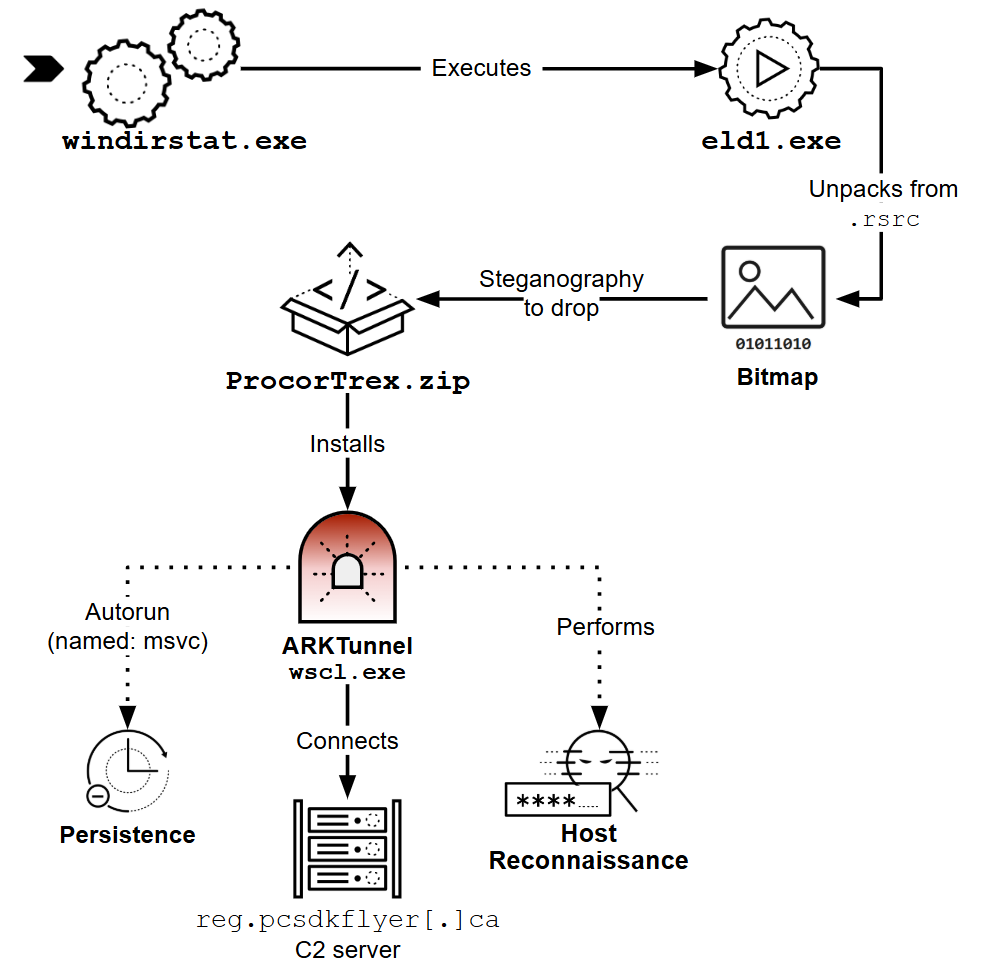
Rather than dropping an executable directly to disk, eld1.exe extracts a ZIP archive from a BMP image resource using LSB steganography. The result is the payload archive, ProcorTrex.zip, which contains wscl.exe, a previously unreported WebSocket-based tunneling RAT. We named this RAT ARKTunnel, based on the attacker's fabricated company name rotation of EarthKark and TamarkLark.
ARKTunnel installs itself as a Windows service named wscl-13 or msvcsrvc with a delayed autostart configuration. The RAT supports TCP and UDP tunneling, as well as file execution.
The C2 server address, reg.pcsdkflyer[.]ca, is decoded from a 39-byte configuration blob using Base64-decoding followed by an XOR decryption routine. The portable executable (PE) metadata of wscl.exe contains a fabricated company name, TamarkLark Corporation, and a fictitious product name, TamarkLark Manager, which led us to suspect that other ARKTunnel samples might use additional fabricated company names.
The investigation revealed at least 50 samples deployed over the course of a year. The developer rotated through at least two fake company identities while maintaining an identical icon, binary structure and deployment pattern:
- EarthLink in May 2025: EarthLink is the name of a legitimate internet provider, however the attackers used this name coincidentally in the file version information. The attackers did not use or impersonate EarthLink resources or identity.
- EarthChain from May 2025–April 2026: EarthChain is also real company name that the attackers used coincidentally. Likewise, also they did not use or impersonate the company’s resources or identity.
- EarthKark: A fake identity, used from February 2026–June 2026
- TamarkLark: A fake identity, used from March 2026–June 2026
All of the samples share the same wscl.exe filename pattern and GUID-based temp directory extraction pattern, indicating that they are variants of the same family.
Despite 50 samples spanning a full year of development and four identity rotations, ARKTunnel has attracted no public reporting or dedicated tracking, with each sample individually flagged as a generic Trojan rather than recognized as a tunneling implant.
Operation C: Docro Hijacker – Reviving Old Techniques
The eld2.exe payload installs a Chrome browser hijacker that we have named Docro Hijacker. The hijacker revives a browser-hijacking technique that has resurfaced periodically since 2015, now re-engineered to bypass updates to Chrome's integrity protections. While this iteration closely mirrors a proof-of-concept detailed by Synacktiv in 2025, this campaign marks the updated technique’s first documented instance of in-the-wild deployment.
Figure 9 shows the Docro Hijacker installation chain.
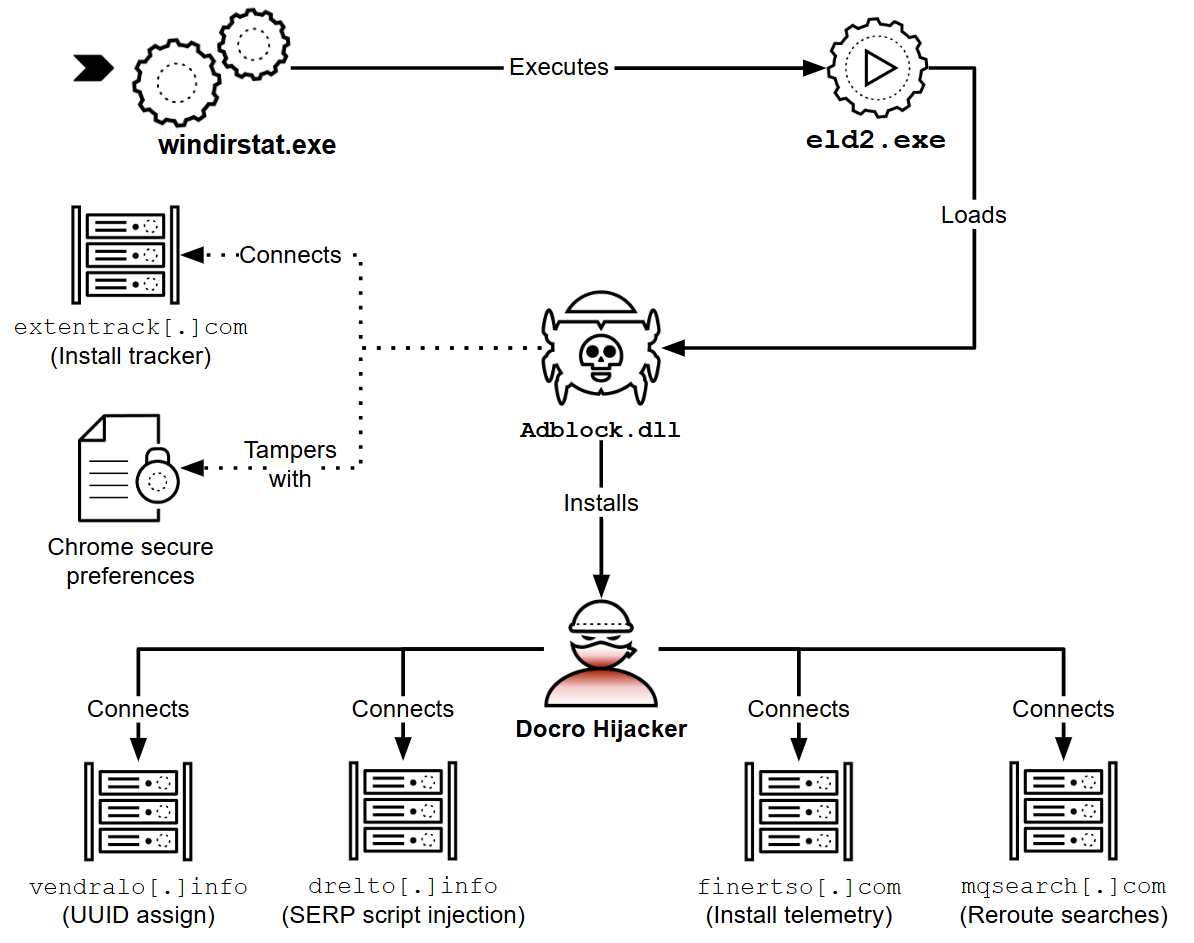
eld2.exe is an Inno Setup package, and much like its loader, it extracts and runs eld2.tmp which contacts the affiliate’s extentrack[.]com install tracker.
eld2.tmp drops and loads Adblock.dll, which bypasses Chrome's Secure Preferences HMAC-SHA256 integrity check. The DLL extracts Chrome's HMAC key from resources.pak, computes valid HMAC signatures for the modified preference values and writes them directly to the Secure Preferences file. This file functions as an anti-tamper mechanism for browsers by storing a validated copy of the user's settings.
This manipulation allows the malware to execute two primary actions:
- Search hijacking: Changes the default search provider to mqsearch[.]com, a domain that masquerades as a search engine
- Extension installation: Installs the docro extension, a Chrome Manifest V3 extension located at C:\ProgramData\DocsHelper\docro\
The docro extension uses Chrome's declarativeNetRequest API to dynamically rewrite network requests. Upon installation, it contacts vendralo[.]info to retrieve a unique per-victim UUID and fetch a set of network rewriting rules that are refreshed hourly.
These rules are used to hijack and monetize search results in the victim's browser. When the victim performs an internet search, across any of more than 190 Google country-code domains, the extension loads a script from drelto[.]info/farlix into the search results page. Because the script runs within the search engine's own origin context, it has full access to the page content. This enables the operator to inject advertisements into organic search results, rewrite affiliate links to capture referral revenue and/or redirect clicks to attacker-controlled destinations. These actions are functionally transparent to the user and visually indistinguishable from the legitimate search page.
The extension also checks vendralo[.]info for updates via /extensionInstaller/updateChromeExtension, allowing the operator to silently rotate to a new extension version at any time. Install telemetry is reported to finersto[.]com and extentrack[.]com.
With more than 50 unique samples contacting mqsearch[.]com according to VirusTotal, Docro Hijacker appears to be a mature, independent monetization module.
Conclusion
The actors behind CL-CRI-1171 did not use sophisticated evasion techniques, but focused their efforts on building a loader that is exceptionally difficult to track due to its clever gating mechanisms.
Our investigation highlights how the authors of OfferLoader, by being intentional about its simplicity and by hiding all of its functions as bytecode within a package, designed the malware to evade scrutiny while quietly building a massive, mature infection funnel.
Although OfferLoader was easy for defenders and security products to miss, its gating mechanisms were not, and the sheer number of them was our first clue that more widespread activity was occurring.
While a loader that just drops a payload is seemingly routine, this mechanism allowed possibly thousands of rotational malware bundles, including entirely new and undocumented malware families, to remain hidden from standard security attention. Ultimately, this case serves as a critical reminder for defenders: Treating commodity loader infections as minor, routine events overlooks the dangerous payloads and campaigns that might be tied to them.
Palo Alto Networks Protection and Mitigation
Palo Alto Networks customers are better protected against the threats described in this report through the following products and services:
- The Advanced WildFire machine-learning models and analysis techniques have been reviewed and updated in light of the indicators shared in this research. Through continuous cloud-based analysis, Advanced WildFire is designed to proactively identify and block OfferLoader samples as well as downstream payloads, including Insomnia RAT, ARKTunnel, and Docro Hijacker.
- Advanced URL Filtering and Advanced DNS Security identify known domains and URLs associated with this activity as malicious.
- Cortex XDR and XSIAM can help detect and prevent the OfferLoader chain and all three payload branches described in this article. Cortex customers benefit from multiple layers of protection against this threat, including:
- YARA-based signatures targeting the OfferLoader family and its staged payloads
- Behavioral detection rules that help prevent:
- Malicious Chrome extension setup
- Untrusted service installations used for persistence
- Trojanized installer execution patterns
If you think you may have been compromised or have an urgent matter, get in touch with the Unit 42 Incident Response team or call:
- North America: Toll Free: +1 (866) 486-4842 (866.4.UNIT42)
- UK: +44.20.3743.3660
- Europe and Middle East: +31.20.299.3130
- Asia: +65.6983.8730
- Japan: +81.50.1790.0200
- Australia: +61.2.4062.7950
- India: 000 800 050 45107
- South Korea: +82.080.467.8774
Palo Alto Networks has shared these findings with our fellow Cyber Threat Alliance (CTA) members. CTA members use this intelligence to rapidly deploy protections to their customers and to systematically disrupt malicious cyber actors. Learn more about the Cyber Threat Alliance.
Indicators of Compromise
Initial Access and OfferLoader
SHA256 hash: 7f792c45de1e28fd42ac44c9444f157a2161742d130bac336c0e991aabbb112c
File name: windirstat.exe
File type: PE32 executable, Inno Setup 6.7.1
File description: OfferLoader trojanized WinDirStat installer delivered via SEO-poisoning
SHA256 hash: fc485882626512e7ff82a1d7cd8e8fb3e9751b026d97e682d6908aefff1f2d73
File name: windirstat.tmp
File type: PE32 executable, Inno Setup unpacked stage
File description: Unpacked WinDirStat stage
Operation A: Insomnia RAT
SHA256 hash: 3052bd320a34e12ee694811ed0578797477dfd480c664491e509ed15ce1a6961
File name: eld0.exe
File type: PE32 executable, Inno Setup 6.3.0 SetupLdr
File description: Insomnia RAT initial loader
SHA256 hash: 25558ea78c4aa0fdd0f45fafcaa546d3115dc5806809d144a5801a40e48fd4c5
File name: eld0.tmp
File type: PE32 executable, Inno Setup unpacked stage
File description: Unpacked loader stage
SHA256 hash: 9b0d9cbc0fd4a7bae8b78a15dfbe63052779414ad725845732c4a0083008da69
File name: a.dll
File type: PE32 DLL
File description: Executes the PowerShell downloader for the Node.js and Python second stages
SHA256 hash: ceb30a5eb9ad9d9c6712c80726df16f96f99d9fc0753be241b00b4d636eb576e
File name: t.ps1
File type: PowerShell
File description: Insomnia RAT PowerShell loader
SHA256 hash: cf184d04ca31fb2b6b7efd85399c29c1136b539153e137ceb3877b1b905791de
File name: <guid>.py
File type: Python script
File description: the Python-based component of the Insomnia RAT dual payload.
SHA256 hash: 62d49d0c78207ec2452cc8a30501db771c9edbae89889e41a7dd227551243e8e
File name: aa.js
File type: JavaScript
File description: the Node.js-based component of the Insomnia RAT dual payload.
URL: hxxps[:]//stryper[.]info/t.ps1
Description: Stage-2 PowerShell installer for the Node.js and Python agents
URL: hxxps[:]//stryper[.]info/aa.js
Description: Stage-3 Node.js agent
URL: hxxp[:]//aa.amazingshield[.]xyz/33244556546.py
Description: Stage-3 Python agent
Domain: stryper[.]info
Description: Second-stage PowerShell and Node.js agent host
Domain: aa.amazingshield[.]xyz
Description: Python agent host
Domain: crowdstri[.]com
Description: CrowdStrike-typosquat C2 for the Python agent
Operation B: ARKTunnel
SHA256 hash: aaebc8c07de485be6d1bfa956668c5e18aa1ff5588dfe84672e20ae90b4560f1
File name: eld1.exe
File type: PE32 executable
File description: LSB-steganography dropper. The attacker forged the PE version-info resource to mimic a popular test proctoring application.
SHA256 hash: e05bc22afbc5ddd50b49c85ee169dd13318000d38286de2b8bcff98217256a8d File size: 92,657 bytes
File name: procorTrex.zip
File location: C:\Users\Public\procorTrex.zip
File type: ZIP archive
File description: ZIP carved from the eld1.exe BMP steganography payload
SHA256 hash: b367762140ae7f5098230b8a5da738c9241f286281ec9439dd6ca581fc87989c File size: 245,248 bytes
File name: wscl.exe
File type: PE32 executable
File description: WebSocket tunneling RAT
ARKTunnel resource icons:
SHA256 hash: d8d783f8e050a6e394f3c0aa5e2bc73a38d822e55fbc39c0648cbff566de3cdf
File description: Resource Icon shared across ARKTunnel samples
SHA256 hash: 06e0afd01bbc6c9d5dc16c3165089b233dc071e1f251abd06235d1b9166cdac5
File description: Resource Icon shared across ARKTunnel samples
Domain: reg.pcsdkflyer[.]ca
Description: wscl.exe WebSocket RAT C2
Operation C: Docro Hijacker
SHA256 hash: 2c6e11027b011042c9a118fc20728f8f4ebb6be8795cc84cc9a45622c297d354
File name: eld2.exe
File type: PE32 executable, Inno Setup installer
File description: Branch C installer that drops Adblock.dll and the docro Chrome extension
SHA256 hash: 553ce594c9c6afdd4794fddc28c194e3bc3c1b052310e5099c58ac15bab72104
File name: eld2.tmp
File type: PE32 executable
File description: Inno Setup unpacked stage
SHA256 hash: fdcc95b7791c0d6590dcf1a412dc9fcc92ad2095818d1b78368b31efad012007
File size: 3,041,280 bytes
File name: Adblock.dll
File location: %TEMP%\Adblock.dll
File type: PE32 DLL
File description: Chrome Secure Preferences HMAC-SHA256 bypass DLL that sideloads the docro extension and hijacks the default search provider
Docro extension path:
File location: C:\ProgramData\DocsHelper\docro
File description: Manifest V3 Chrome extension sideloaded by Adblock.dll
Domain: vendralo[.]info
Description: Per-victim UUID and hourly rule delivery
Domain: finersto[.]com
Description: Extension install and start telemetry
Domain: drelto[.]info
Description: SERP-injection script host
Domain: mqsearch[.]com
Description: Hijacked the default search provider endpoint
Domain: extentrack[.]com
Description: Docs Helper install-success and install-failure callback
CL-CRI-1171 Rotational Infrastructure
Initial-Access Lure and SEO File-Locker Hosts
| Domain | Role |
| noiseship[.]cfd | SEO-poison domain |
| atthelake[.]info | Top referring SEO-poison domain |
| uy.basesfiles[.]com | Fake file host |
| basesfile[.]com | Sibling fake file host |
| igk.filexspace[.]com ikx.filexspace[.]com | SEO file-locker lure hosts |
| filexstorage[.]site | SEO file-locker lure host |
| filescloud[.]pro | SEO file-locker lure host |
| zippyfiles[.]net | SEO file-locker lure host |
| mifilesx[.]site | SEO file-locker lure host |
| dw.xrsdownload[.]com | SEO file-locker lure host |
| storage.ggclicker[.]com | SEO file-locker / referrer host |
| watchadvance[.]com | SEO-poisoning domain |
Domains Used to Confirm OfferLoader Installations
Domain:
- animalview[.]xyz
- trickflag[.]info
- suitstraw[.]info
- connect.fuelleg[.]info
- vesselsystem[.]xyz
- minewave[.]info
- collartitle[.]info
- boardmagic[.]info
- placespoon[.]xyz
- needcherries[.]online
Payload-Handoff and Second-Stage Hosts
Install-Tracker Beacons (Operator Panel)
| Domain | Role |
| voyagemist[.]space | PPI affiliate install tracker |
| statementtouch[.]xyz | PPI affiliate install tracker |
| chawton[.]info | PPI affiliate install tracker |
YouTube Funnel – Burner Blogs and Custom-Domain Sites
| Domain Name | Persona | Type |
| velfps.blogspot[.]com | Velvox | Blogspot burner |
| velvoxlab.blogspot[.]com | Velvox | Blogspot burner |
| venrx.blogspot[.]com | Venrx | Blogspot burner |
| venrxhub.blogspot[.]com | Venrx | Blogspot burner |
| venrx[.]xyz | Venrx | Custom-domain burner |
| ravexoffical.blogspot[.]com | Ravex | Blogspot burner |
| adex-blog.blogspot[.]com | Adex | Blogspot burner |
Please note: While Velvox is a real company, the attackers used its name coincidentally. They did not use or impersonate the company’s resources or identity.
Additional Resources
- “WinYahoo” PUP Modifies Chrome Secure Preferences – Malwarebytes
- NodeJS backdoors delivering proxyware and monetization schemes – Walmart Global Tech blog
Appendix A: CL-CRI-1171 Full Discovered Infrastructure Tables
| Indicator | Role |
| achievershelf[.]space | Gate/landing |
| activitymeal[.]space | Gate/landing |
| additionplot[.]cfd | Gate/landing |
| adviceturn[.]xyz | Gate/landing |
| afternoonscrew[.]space | Gate/landing |
| agreementjuice[.]space | Gate/landing |
| airplaneiron[.]xyz | Gate/landing |
| airtwig[.]xyz | Gate/landing |
| amountfuel[.]icu | Gate/landing |
| animalrecord[.]xyz | Gate/landing |
| apparatustruck[.]xyz | Gate/landing |
| apparelplate[.]space | Gate/landing |
| archairport[.]xyz | Gate/landing |
| authoritykittens[.]info | Gate/landing |
| babyvein[.]xyz | Gate/landing |
| badgewing[.]xyz | Gate/landing |
| bagcare[.]space | Gate/landing |
| basinpleasure[.]xyz | Gate/landing |
| basketballyear[.]xyz | Gate/landing |
| baskethumor[.]xyz | Gate/landing |
| bedroomdesire[.]xyz | Gate/landing |
| beliefpicture[.]xyz | Gate/landing |
| bellplayground[.]xyz | Gate/landing |
| bikesdonkey[.]info | Gate/landing |
| birthdaymagic[.]xyz | Gate/landing |
| boatthought[.]xyz | Gate/landing |
| boundarychickens[.]xyz | Gate/landing |
| boytank[.]xyz | Gate/landing |
| branchmorning[.]xyz | Gate/landing |
| breathdoctor[.]xyz | Gate/landing |
| bubbleslip[.]xyz | Gate/landing |
| cabbagemeasure[.]xyz | Gate/landing |
| cablecanvas[.]xyz | Gate/landing |
| cardgrape[.]xyz | Gate/landing |
| cattlegold[.]xyz | Gate/landing |
| celeryerror[.]xyz | Gate/landing |
| centscarf[.]xyz | Gate/landing |
| chalkprose[.]xyz | Gate/landing |
| cherriestruck[.]space | Gate/landing |
| chesstail[.]xyz | Gate/landing |
| chickensmine[.]space | Gate/landing |
| churchpail[.]xyz | Gate/landing |
| clothcrib[.]xyz | Gate/landing |
| clothcurrent[.]xyz | Gate/landing |
| coatberry[.]xyz | Gate/landing |
| connect.activitykitty[.]xyz | Install tracker |
| connect.apparatustaste[.]xyz | Install tracker |
| connect.armcard[.]xyz | Install tracker |
| connect.badgeterritory[.]xyz | Install tracker |
| connect.baitmetal[.]xyz | Install tracker |
| connect.beefteeth[.]xyz | Install tracker |
| connect.believesisters[.]xyz | Install tracker |
| connect.boundaryfly[.]xyz | Install tracker |
| connect.bubbleappliance[.]xyz | Install tracker |
| connect.cableland[.]xyz | Install tracker |
| connect.chinexpert[.]xyz | Install tracker |
| connect.conditiongrade[.]xyz | Install tracker |
| connect.coppersummer[.]xyz | Install tracker |
| connect.creatorcreator[.]xyz | Install tracker |
| connect.dresstent[.]xyz | Install tracker |
| connect.dropjeans[.]xyz | Install tracker |
| connect.edgeplayground[.]xyz | Install tracker |
| connect.exchangeclub[.]xyz | Install tracker |
| connect.existencediscussion[.]info | Install tracker |
| connect.expansionsalt[.]info | Install tracker |
| connect.fangstitch[.]xyz | Install tracker |
| connect.fogparcel[.]info | Install tracker |
| connect.foodhook[.]info | Install tracker |
| connect.forkcountry[.]xyz | Install tracker |
| connect.geesepurpose[.]xyz | Install tracker |
| connect.giantsdogs[.]info | Install tracker |
| connect.giraffetoothpaste[.]xyz | Install tracker |
| connect.guitarrobin[.]xyz | Install tracker |
| connect.halllunch[.]info | Install tracker |
| connect.harborclam[.]xyz | Install tracker |
| connect.holecompany[.]info | Install tracker |
| connect.knifesea[.]icu | Install tracker |
| connect.monthsmoke[.]info | Install tracker |
| connect.nosegovernor[.]xyz | Install tracker |
| connect.pagesubstance[.]xyz | Install tracker |
| connect.poisonblade[.]xyz | Install tracker |
| connect.prosesalt[.]xyz | Install tracker |
| connect.purposethings[.]info | Install tracker |
| connect.quiltgirls[.]xyz | Install tracker |
| connect.reactionbit[.]info | Install tracker |
| connect.rewardrun[.]xyz | Install tracker |
| connect.riceapparel[.]xyz | Install tracker |
| connect.seashoreletters[.]info | Install tracker |
| connect.selectiondogs[.]xyz | Install tracker |
| connect.shapeboot[.]info | Install tracker |
| connect.shoptax[.]xyz | Install tracker |
| connect.stopfinger[.]info | Install tracker |
| connect.structurekiss[.]xyz | Install tracker |
| connect.tanksuggestion[.]xyz | Install tracker |
| connect.thingbrass[.]xyz | Install tracker |
| connect.thoughtslave[.]xyz | Install tracker |
| connect.threadfuel[.]xyz | Install tracker |
| connect.trailcontrol[.]xyz | Install tracker |
| connect.trickbushes[.]info | Install tracker |
| connect.vacationthought[.]xyz | Install tracker |
| connect.viewschool[.]xyz | Install tracker |
| connect.voyagelaugh[.]xyz | Install tracker |
| connect.woolreward[.]xyz | Install tracker |
| connect.yearicicle[.]xyz | Install tracker |
| connect.zebratransport[.]xyz | Install tracker |
| controlprice[.]xyz | Gate/landing |
| coughcoal[.]icu | Gate/landing |
| countrypipe[.]space | Gate/landing |
| cowsfoot[.]xyz | Gate/landing |
| crackfood[.]space | Gate/landing |
| creamfurniture[.]space | Gate/landing |
| creditchickens[.]xyz | Gate/landing |
| crediteducation[.]cfd | Gate/landing |
| crimestreet[.]xyz | Gate/landing |
| crimesupport[.]cfd | Gate/landing |
| curvebite[.]xyz | Gate/landing |
| deathrock[.]xyz | Gate/landing |
| deathshop[.]xyz | Gate/landing |
| decisionreaction[.]xyz | Gate/landing |
| dinosaursjam[.]cfd | Gate/landing |
| distancebedroom[.]xyz | Gate/landing |
| distributiontheory[.]cfd | Gate/landing |
| dolldebt[.]xyz | Gate/landing |
| doorsoap[.]cfd | Gate/landing |
| dustprotest[.]icu | Gate/landing |
| expansionsalt[.]info | Gate/landing |
| fallbeginner[.]xyz | Gate/landing |
| fangbear[.]xyz | Gate/landing |
| filescenter[.]cloud | Gate/landing |
| filesilo[.]cloud | Gate/landing |
| fingerbasketball[.]xyz | Gate/landing |
| flavorwood[.]xyz | Gate/landing |
| fleshfrog[.]xyz | Gate/landing |
| fleshplants[.]xyz | Gate/landing |
| fleshproduce[.]xyz | Gate/landing |
| foodrock[.]space | Gate/landing |
| forkmice[.]xyz | Gate/landing |
| friendjewel[.]cfd | Gate/landing |
| geeseairport[.]xyz | Gate/landing |
| girlsgrain[.]xyz | Gate/landing |
| glassmove[.]xyz | Gate/landing |
| goldsteel[.]cfd | Gate/landing |
| governmentyard[.]cfd | Gate/landing |
| grandfatherquiver[.]xyz | Gate/landing |
| gripcollar[.]xyz | Gate/landing |
| gripsleep[.]xyz | Gate/landing |
| gunbear[.]xyz | Gate/landing |
| hairreward[.]xyz | Gate/landing |
| hatescale[.]info | Gate/landing |
| healthiron[.]space | Gate/landing |
| holemuscle[.]xyz | Gate/landing |
| homecub[.]cfd | Gate/landing |
| homefireman[.]xyz | Gate/landing |
| honeyfear[.]xyz | Gate/landing |
| ilesilo[.]cloud | Gate/landing |
| instrumentvolcano[.]space | Gate/landing |
| kittenschalk[.]xyz | Gate/landing |
| kittensgrade[.]cfd | Gate/landing |
| kittensrobin[.]info | Gate/landing |
| landerror[.]xyz | Gate/landing |
| lesilo[.]cloud | Gate/landing |
| liptendency[.]info | Gate/landing |
| liquidtoes[.]xyz | Gate/landing |
| liquidwrench[.]cfd | Gate/landing |
| lockettrail[.]xyz | Gate/landing |
| lumberbaseball[.]xyz | Gate/landing |
| memorycompany[.]xyz | Gate/landing |
| micesisters[.]xyz | Gate/landing |
| milkname[.]xyz | Gate/landing |
| minuteblade[.]xyz | Gate/landing |
| mountainsurprise[.]cfd | Gate/landing |
| mouthfruit[.]cfd | Gate/landing |
| noiseship[.]cfd | Gate/landing |
| northbox[.]xyz | Gate/landing |
| partpipe[.]xyz | Gate/landing |
| partyfriends[.]cfd | Gate/landing |
| passengerbrake[.]space | Gate/landing |
| peacejewel[.]xyz | Gate/landing |
| peacetongue[.]xyz | Gate/landing |
| petminister[.]xyz | Gate/landing |
| pictureporter[.]cfd | Gate/landing |
| pieplant[.]space | Gate/landing |
| pizzasthread[.]xyz | Gate/landing |
| pleasurewaves[.]info | Gate/landing |
| popcornregret[.]xyz | Gate/landing |
| porterdebt[.]xyz | Gate/landing |
| powerbushes[.]xyz | Gate/landing |
| profitfact[.]xyz | Gate/landing |
| prosetoothbrush[.]xyz | Gate/landing |
| quincepage[.]xyz | Gate/landing |
| raintexture[.]xyz | Gate/landing |
| rakepurpose[.]xyz | Gate/landing |
| raterake[.]cfd | Gate/landing |
| readingscience[.]xyz | Gate/landing |
| reasonachiever[.]xyz | Gate/landing |
| recessgiraffe[.]xyz | Gate/landing |
| recordhistory[.]xyz | Gate/landing |
| regretsquirrel[.]xyz | Gate/landing |
| restbucket[.]xyz | Gate/landing |
| ricestar[.]xyz | Gate/landing |
| rifledog[.]xyz | Gate/landing |
| ringsparcel[.]xyz | Gate/landing |
| roadyear[.]xyz | Gate/landing |
| rockcredit[.]space | Gate/landing |
| rollglass[.]xyz | Gate/landing |
| roofbattle[.]xyz | Gate/landing |
| roofreaction[.]xyz | Gate/landing |
| rosegrip[.]xyz | Gate/landing |
| routeletters[.]xyz | Gate/landing |
| runhouses[.]xyz | Gate/landing |
| scarecrowcare[.]xyz | Gate/landing |
| scentrod[.]info | Gate/landing |
| screwbirth[.]xyz | Gate/landing |
| seatlace[.]space | Gate/landing |
| seaword[.]xyz | Gate/landing |
| servantadvice[.]xyz | Gate/landing |
| shiptank[.]cfd | Gate/landing |
| shirtexample[.]xyz | Gate/landing |
| shoesearthquake[.]xyz | Gate/landing |
| sinkwash[.]space | Gate/landing |
| skirtloss[.]xyz | Gate/landing |
| slipvegetable[.]xyz | Gate/landing |
| smokecar[.]space | Gate/landing |
| songtheory[.]xyz | Gate/landing |
| spadeleg[.]xyz | Gate/landing |
| sparkrice[.]space | Gate/landing |
| sparkrub[.]xyz | Gate/landing |
| spoonducks[.]cfd | Gate/landing |
| springdogs[.]xyz | Gate/landing |
| spybaseball[.]space | Gate/landing |
| startmonkey[.]cfd | Gate/landing |
| statementservant[.]xyz | Gate/landing |
| statementtouch[.]xyz | Gate/landing |
| steamhouses[.]cfd | Gate/landing |
| stopzinc[.]xyz | Gate/landing |
| structurelinen[.]xyz | Gate/landing |
| suggestioncemetery[.]xyz | Gate/landing |
| suitsoap[.]xyz | Gate/landing |
| suitstraw[.]info | Gate/landing |
| swimrest[.]xyz | Gate/landing |
| tablechess[.]info | Gate/landing |
| tailsilk[.]xyz | Gate/landing |
| territorycaption[.]xyz | Gate/landing |
| texturebadge[.]xyz | Gate/landing |
| thrillducks[.]xyz | Gate/landing |
| throneback[.]xyz | Gate/landing |
| tinsofa[.]xyz | Gate/landing |
| toespiders[.]xyz | Gate/landing |
| toothpastesense[.]xyz | Gate/landing |
| toothpastesun[.]xyz | Gate/landing |
| townquiver[.]xyz | Gate/landing |
| trampdonkey[.]icu | Gate/landing |
| treesboard[.]xyz | Gate/landing |
| truckpig[.]cfd | Gate/landing |
| truckshat[.]xyz | Gate/landing |
| turnclass[.]xyz | Gate/landing |
| umbrellavessel[.]xyz | Gate/landing |
| vacationengine[.]xyz | Gate/landing |
| vesselsystem[.]xyz | Gate/landing |
| vestthings[.]cfd | Gate/landing |
| volcanopin[.]xyz | Gate/landing |
| voyagemist[.]space | Gate/landing |
| wastereading[.]xyz | Gate/landing |
| wasteturkey[.]xyz | Gate/landing |
| wastewine[.]xyz | Gate/landing |
| wavepan[.]xyz | Gate/landing |
| whistlebook[.]cfd | Gate/landing |
| whistlesong[.]xyz | Gate/landing |
| wormspark[.]xyz | Gate/landing |
| woundsecretary[.]xyz | Gate/landing |
| wrenobservation[.]xyz | Gate/landing |
| yamsmell[.]xyz | Gate/landing |
| yardvalue[.]cfd | Gate/landing |
| zephyrhall[.]cfd | Gate/landing |
Appendix B: YouTube Channels Linked to CL-CRI-1171 Activity
(Channels were taken down after we notified Google.)
| Persona | Channel |
| Velvox | @VelvoxYT |
| Venrx | @Venrx |
| Ravex | @RAVEX-wu1pg |
| Adex | @adex915 |
| Ripex | @ripex |
| HASNZ TWEAKS | @hasnzyt |
| Ontrendytt | @OnTrendd |
| Trend Rise | @trendrise |
| Reknotic Lab | @Reknotic |
| NowFixTutorials | @NowFixTutorials |
| f4fix | @f4fix |
Table of Contents
Related Malware Resources

 Threat Research






 High Profile Threats


 Get updates from Unit 42